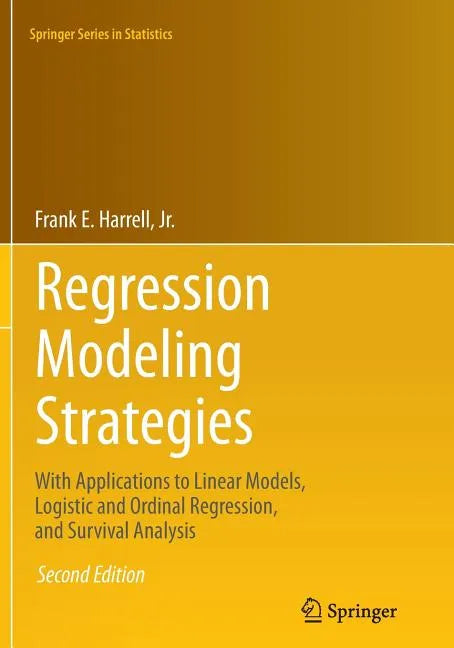
Regression Modeling Strategies: With Applications to Linear Models, Logistic and Ordinal Regression, and Survival Analysis - Paperback
Regression Modeling Strategies: With Applications to Linear Models, Logistic and Ordinal Regression, and Survival Analysis - Paperback
Couldn't load pickup availability
by Frank E. Harrell Jr (Author)
There are many books that are excellent sources of knowledge about individual stastical tools (survival models, general linear models, etc.), but the art of data analysis is about choosing and using multiple tools. In the words of Chatfield "...students typically know the technical details of regressin for example, but not necessarily when and how to apply it. This argues the need for a better balance in the literature and in statistical teaching between techniques and problem solving strategies." Whether analyzing risk factors, adjusting for biases in observational studies, or developing predictive models, there are common problems that few regression texts address. For example, there are missing data in the majority of datasets one is likely to encounter (other than those used in textbooks!) but most regression texts do not include methods for dealing with such data effectively, and texts on missing data do not cover regression modeling.
Back Jacket
This highly anticipated second edition features new chapters and sections, 225 new references, and comprehensive R software. In keeping with the previous edition, this book is about the art and science of data analysis and predictive modeling, which entails choosing and using multiple tools. Instead of presenting isolated techniques, this text emphasizes problem solving strategies that address the many issues arising when developing multivariable models using real data and not standard textbook examples. It includes imputation methods for dealing with missing data effectively, methods for fitting nonlinear relationships and for making the estimation of transformations a formal part of the modeling process, methods for dealing with "too many variables to analyze and not enough observations," and powerful model validation techniques based on the bootstrap. The reader will gain a keen understanding of predictive accuracy, and the harm of categorizing continuous predictors or outcomes. This text realistically deals with model uncertainty, and its effects on inference, to achieve "safe data mining." It also presents many graphical methods for communicating complex regression models to non-statisticians.
Regression Modeling Strategies presents full-scale case studies of non-trivial datasets instead of over-simplified illustrations of each method. These case studies use freely available R functions that make the multiple imputation, model building, validation, and interpretation tasks described in the book relatively easy to do. Most of the methods in this text apply to all regression models, but special emphasis is given to multiple regression using generalized least squares for longitudinal data, the binary logistic model, models for ordinal responses, parametric survival regression models, and the Cox semiparametric survival model. A new emphasis is given to the robust analysis of continuous dependent variables using ordinal regression.
As in
the first edition, this text is intended for Masters' or Ph.D. level graduate students who have had a general introductory probability and statistics course and who are well versed in ordinary multiple regression and intermediate algebra. The book will also serve as a reference for data analysts and statistical methodologists, as it contains an up-to-date survey and bibliography of modern statistical modeling techniques. Examples used in the text mostly come from biomedical research, but the methods are applicable anywhere predictive models ("analytics") are useful, including economics, epidemiology, sociology, psychology, engineering, and marketing.Author Biography
Frank E. Harrell, Jr. is Professor of Biostatistics and Chair, Department of Biostatistics, Vanderbilt University School of Medicine, Nashville. He has developed numerous methods for predictive modeling, quantifying predictive accuracy and model validation and has published numerous predictive models and articles on applied statistics, medical research and clinical trials. He is on the editorial board for several biomedical and methodologic journals. He is a Fellow of the American Statistical Association (ASA) and a consultant to the U.S. Food and Drug Administration and to the pharmaceutical industry. He teaches a graduate course in regression modeling strategies and a course in biostatistics for medical researchers. In 2014 he was chosen to receive the WJ Dixon Award for Excellence in Statistical Consulting by the ASA.