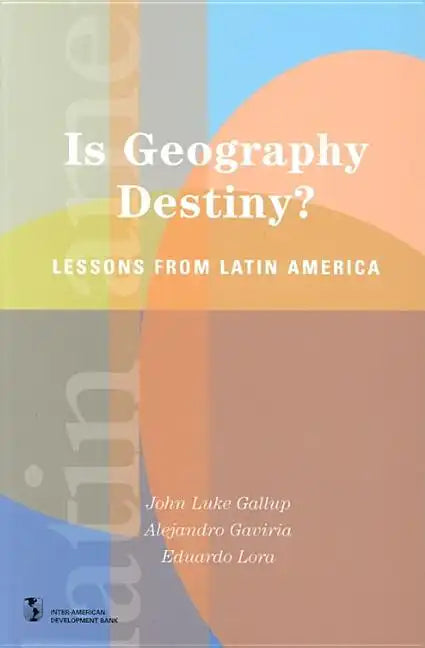
Is Geography Destiny?: Lessons from Latin America - Paperback
Is Geography Destiny?: Lessons from Latin America - Paperback
Couldn't load pickup availability
by Eduardo Lora (Editor), John Luke Gallup (Editor), Alejandro Gaviria (Editor)
Geographic interpretations of development recently have become the subject of much renewed interest and debate within scholarly and public policy circles. Focusing on Latin America, this book examines how physical and human geography has influenced the region's potential for economic and social development.
The book assesses how geography affects differences in development between countries and more specifically between Latin America and other regions of the world. The effects of geography on regional development are examined through four channels: the productivity of land, health conditions, frequency and intensity of natural disasters, and access to markets. The book then explores how geography has influenced development within countries through case studies of Bolivia, Brazil, Colombia, Mexico, and Peru-countries significant for their geographical diversity as well as their wide socioeconomic disparities. These case studies illustrate numerous exceptions to international patterns and prove that while geography matters, it need not determine a country's destiny.
Using the knowledge gained from these two perspectives, the book concludes with recommendations for policies that can help countries overcome the limitations imposed by geography and thereby enhance their potential for economic and social development.
Front Jacket
Geographic interpretations of development recently have become the subject of much renewed interest and debate within scholarly and public policy circles. Focusing on Latin America, this book examines how physical and human geography has influenced the region's potential for economic and social development.
The book assesses how geography affects differences in development between countries and more specifically between Latin America and other regions of the world. The effects of geography on regional development are examined through four channels: the productivity of land, health conditions, frequency and intensity of natural disasters, and access to markets. The book then explores how geography has influenced development within countries through case studies of Bolivia, Brazil, Colombia, Mexico, and Peru--countries significant for their geographical diversity as well as their wide socioeconomic disparities. These case studies illustrate numerous exceptions to international patterns and prove that while geography matters, it need not determine a country's destiny.
Using the knowledge gained from these two perspectives, the book concludes with recommendations for policies that can help countries overcome the limitations imposed by geography and thereby enhance their potential for economic and social development.
Back Jacket
..".It is a very illustrative example of how geography is being reincorporated into other fields of investigation, and geographers should be aware of the ways in which this is being accomplished."--Progress in Human Geography
"Latin America presents us with two fascinating natural experiments on how geography influences economic development. The 'outer experiment' compares different countries, while the 'inner experiment' compares different zones within the same country. This book's account of all these comparisons will appeal to anyone interested in economic development in general, and in Latin America in particular." --Jared Diamond, author of Guns, Germs, and Steel
Author Biography
John Luke Gallup is an economic consultant and former Research Fellow at the Center for International Development at Harvard University. Alejandro Gaviria is the Deputy Director of the National Planning Department of Colombia. Eduardo Lora is the Principal Advisor of the Research Department of the Inter-American Development Bank.